“I’m exploring sound as a tool to be more intentional with our time in a world of overstimulation. Less distraction helps both focus and sleep.”
Dion LinFounder, NeuroNest Australia
Steady, engineered soundscapes that can make the noise around you stand out less. For focused work, reading and winding down.
 At work
Conversations, phone calls and unexpected sounds interrupt your workflow. A consistent sound environment can help reduce distractions.
Mask conversations and workplace distractions.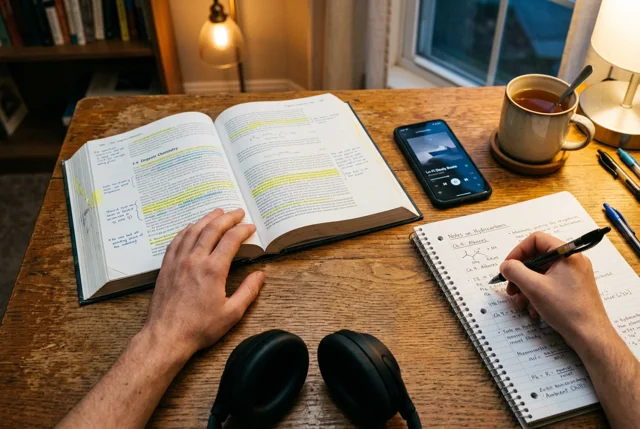 Reading and study
Lyrics and changing melodies compete for your attention, especially when reading or studying.
Reduce interference from music, speech and surrounding noise. At home
Doors closing, passing traffic and nearby activity create sudden changes in noise levels that can pull your attention away.
Create a more consistent acoustic environment for concentration. Winding down
Traffic, neighbours and household activity can make it difficult to relax. A steady background sound can help make these interruptions less noticeable.
Mask environmental noise while relaxing or preparing for sleep.How it works
A steady sound underneath changes how much everything else stands out. It is called acoustic masking, and it is long-established hearing science.
Music often asks for your attention. Lyrics, melody and changes give you something to follow. A steady background has nothing to follow, so it can sit behind what you are doing.
Sometimes music works. This is an option for when it does not.
Some surrounding sounds feel less intrusive. The room feels steadier. After a while the sound itself sits further back in your attention.
It does not cancel noise, and it will not cover everything. Loud, close or irregular sounds can still get through, and nearby speech is harder to cover.
People differ. If you notice no benefit in a place where the noise is really happening, that is a valid result.
Four short steps. Skip them if you already know what you want to try.
Optional: what will you be doing?
Free on the web, with no account. Five minutes is only a convenient trial length, and it says little about sleep.
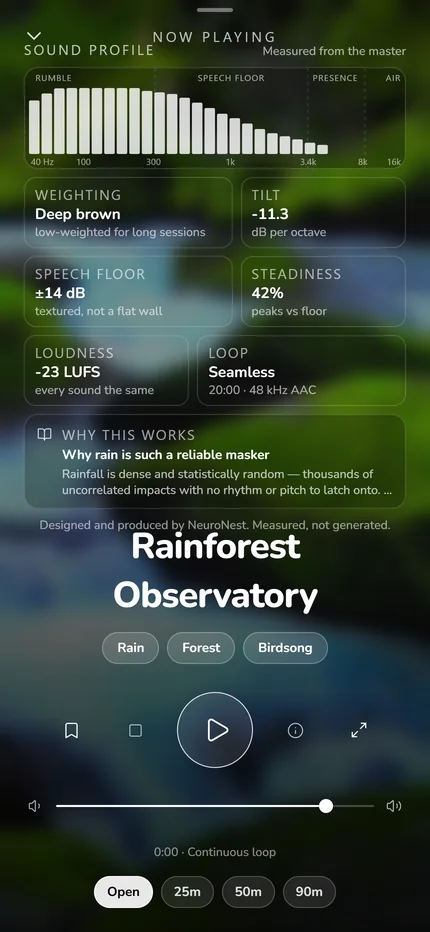
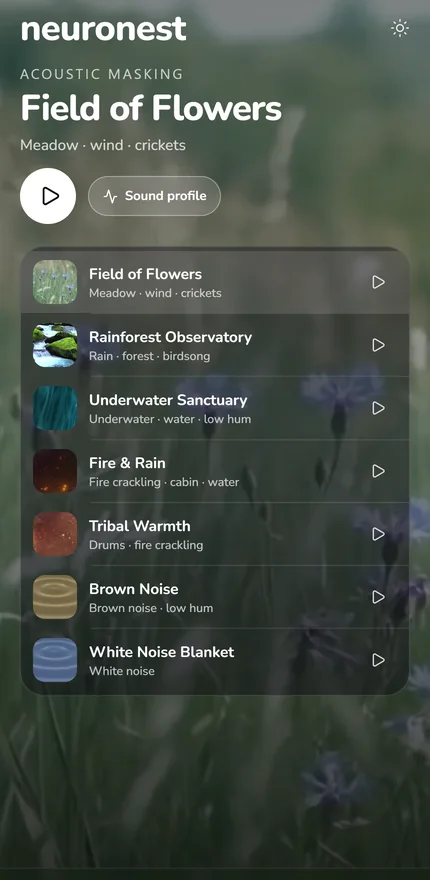
A real recording of the web app. Tap a step to jump to it.
The web app is free on any modern browser. The iPhone app is in private beta: ask for an invite.
The evidence, briefly
A steady sound can make another sound harder to detect. That supports the mechanism. It says nothing specific about any one app.
Studies at work and during sleep vary by setting and person. Reviews of noise for sleep rate the evidence as weak and inconsistent.
We have measured our sound files. We have no outcome studies, so we make no claims about focus, sleep or health results.
These show how common the habit is. They do not show that it works, or that NeuroNest does.
views on one 10-hour white noise video.
YouTube, counted 13 Oct 2026of white noise podcasts played on Spotify each day.
Bloomberg, 2023registered clinical studies of white noise and sleep.
ClinicalTrials.gov, Oct 2026“I’m exploring sound as a tool to be more intentional with our time in a world of overstimulation. Less distraction helps both focus and sleep.”
No. It adds a sound. The noise is still there, and masking can only change how much it stands out. For loud sound, earplugs or noise-cancelling headphones reduce what reaches you, and they can be combined with a background sound.
Start low and stop at a comfortable level, ideally while the distraction is happening. Do not keep turning it up to beat every noise. If your ears feel muffled or ring afterwards, it was too loud.
Either can work. Headphones keep the sound to yourself in a shared space. A speaker across the room is gentler for long sessions. Keep the level low either way.
Yes, many people use steady sound while winding down. Our main tool for sleep is acoustic masking, usually brown or pink noise (what is that?). We are also exploring isochronic tones in the slower theta and delta ranges, but that is early work and not the focus. The evidence for sleep is mixed, and a short daytime trial tells you little about your nights.
No. It does not treat insomnia, ADHD, tinnitus or any other condition. If sleep or attention problems persist, talk to a doctor.
The web app is free with no ads. It never uses your microphone. The site uses Google Analytics to count visits and events such as a sound starting.
Get access to the app. Unsubscribe any time.
Your details stay with NeuroNest.